Zlatko Lakisic

Private Networks Architect & Practice Lead · Enterprise Presales & Connected Solutions
Architecture Case Studies
LinkedIn project highlights expanded into architecture case studies. Each narrative follows the same structure used in enterprise architecture reviews:
| Lens | What it answers |
|---|---|
| Business problem | Why the initiative existed and what was at stake |
| Constraints | Scale, regulation, legacy debt, uptime, or organizational boundaries |
| Architecture | Integration patterns, data flows, and platform decisions |
| Tradeoffs | What was sacrificed or deferred — and why |
| Outcome | Measurable business or operational impact |
Full catalog from LinkedIn.
Omega CMS — Enterprise Content Architecture & Localization
Jan 2017 – Present · omegacms.io · GitHub
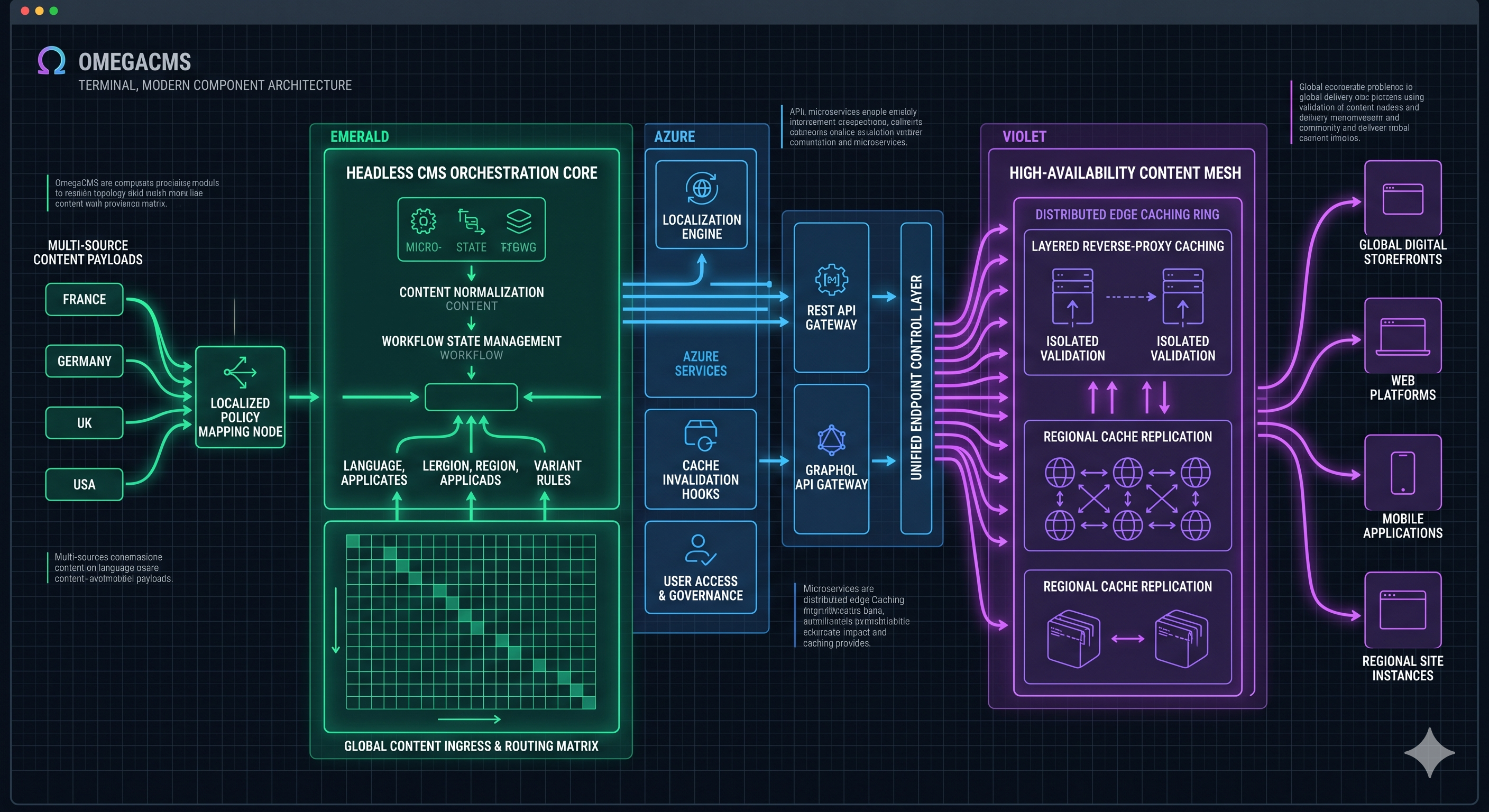
OmegaCMS was engineered as a high-performance, enterprise-grade content management framework designed to decouple content delivery from core business logic. Built to replace rigid, monolithic legacy architectures, the platform established a highly scalable, multi-tenant environment capable of serving dynamic, localized content across global digital properties with ultra-low latency and absolute technical governance. It reads and integrates data from multiple systems, runs on existing infrastructure or as a serverless service, and helps organizations manage content with very little overhead.
The challenge
Prior to implementation, content distribution suffered from severe infrastructure bottlenecks:
- Monolithic lock-in — Content changes required full application deployment cycles, introducing operational risk and stalling time-to-market for digital campaigns.
- Localization friction — Managing content across multiple regions and languages forced teams to maintain separate, siloed application instances, resulting in massive configuration drift.
- Performance degradation — High-traffic spikes routinely threatened database stability due to a lack of an optimized caching and abstraction layer.
Architectural highlights
- Decoupled headless design — Strict headless CMS model exposing content via robust, secure REST API layers (plus client libraries in C#, JavaScript, and TypeScript) to ensure frontend independence and cross-platform flexibility.
- Database-agnostic data layer — SQL Server, MySQL, Oracle, document stores, and flat-file sources through pluggable data access and federated integration.
- Multi-tenant abstraction — Unified localization and translation engine enabling a single codebase to serve multi-region deployments seamlessly.
- Advanced edge caching — High-availability caching hierarchies including reverse-proxy layers and automated cache invalidation hooks to minimize origin server load and optimize Core Web Vitals.
- Serverless deployment — AWS Lambda, Azure Functions, and Google Cloud targets for bursty or globally distributed workloads.
- Content-first modeling — Visual content designer drives generated structures rather than page-builder lock-in.
Business outcomes
- Accelerated time-to-market — Shifted content updates from engineering deployment pipelines to zero-downtime, non-technical editorial workflows.
- Infrastructure savings — Optimized database query layers and caching strategies, reducing operational compute overhead by maximizing hardware performance.
- Global consistency — Established brand and architectural governance across digital channels through a centralized, secure content repository.
Tech stack
Headless CMS · REST APIs · multi-tenant localization · edge caching · .NET Core · federated data integration · AWS Lambda · Azure Functions · Google Cloud · SQL Server · MySQL · Oracle
Role
Co-Founder and Solutions Architect at Omega Content Management Services. Led customer blueprinting, architecture documentation, .NET Core services, federated data integration, and AWS migration playbooks for enterprise clients.
Deep dive → OmegaCMS on GitHub · Resume — Omega IT LLC
Walmart Inventory Automation
Genpact · Walmart & Sam’s Club · 11/2018 – 11/2019
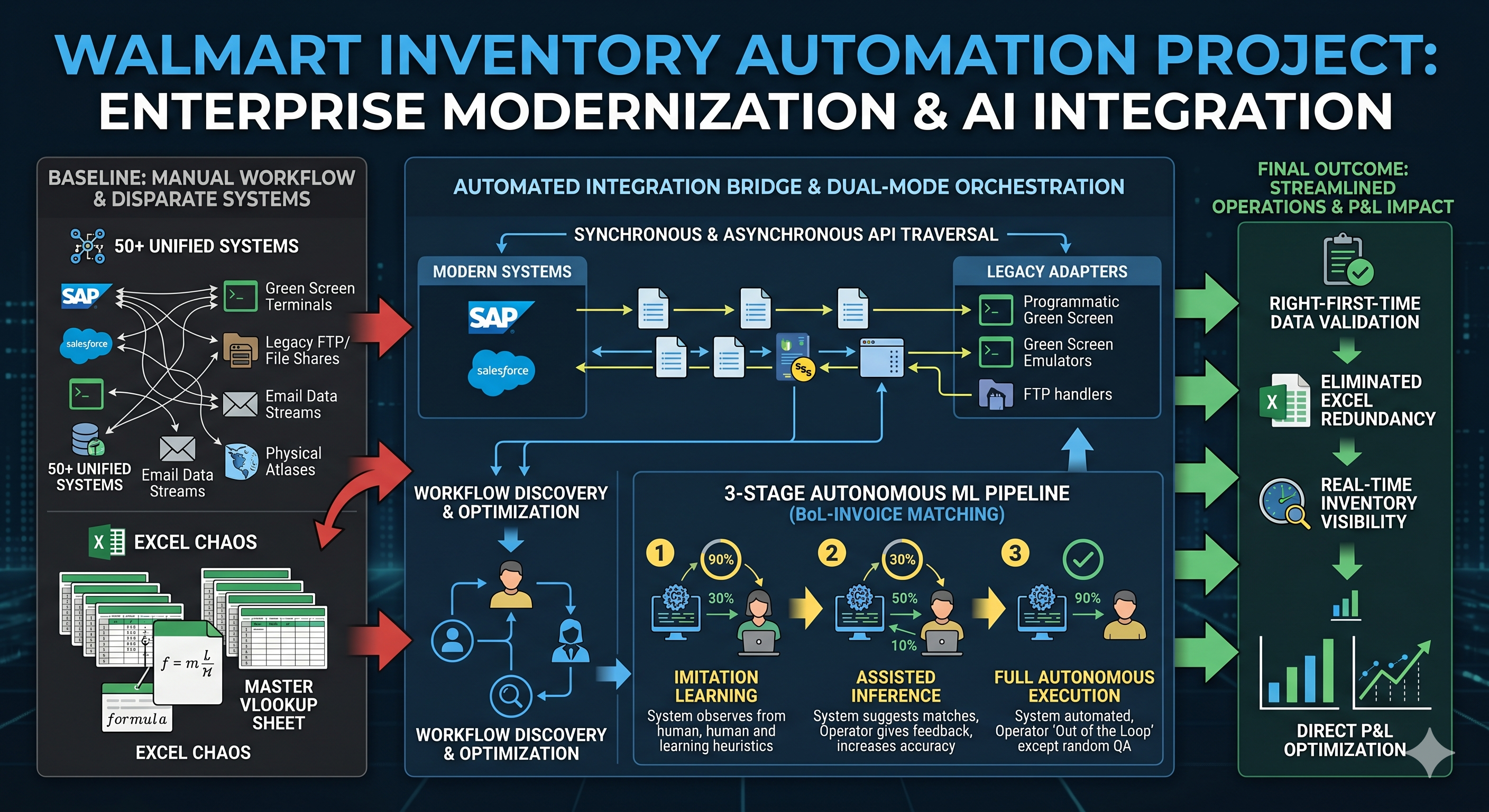
Architectural strategy, re-engineering, and automation of a highly fragmented global supply chain and inventory accounting ecosystem. At enterprise scale, the initiative unified 50+ disparate legacy and modern systems into a resilient dual-mode integration bridge — replacing a brittle manual workflow built on multi-layered spreadsheet networks with a right-first-time data pipeline that secured financial fidelity for metrics directly tied to corporate P&L.
The challenge
The baseline infrastructure was extreme technical debt in a fully siloed operating model:
- Systemic scale — 50+ disconnected platforms, from SAP and Salesforce to mainframe green-screen terminals, independent file shares, and legacy email data streams.
- Geospatial gaps — No unified mapping; logistics teams relied on static paper atlases instead of centralized GIS.
- Spreadsheet dependency — Frontline staff tracked inventory through a fragile Excel matrix fed by 50 individual data-dump sheets into an unstable master VLOOKUP system.
- P&L exposure — Inventory metrics feed corporate profit-and-loss statements; teams reran identical calculation cycles three to four times per period to manually verify integrity.
Architectural highlights
1. Dual-mode integration bridge
Orchestration layer supporting synchronous and asynchronous processing so low-performance legacy systems could not drag down modern cloud applications:
- Synchronous streams — Low-latency API transactions for interactive endpoints (SAP, Salesforce).
- Asynchronous pipelines — Stateful, queue-driven workers for bulk FTP drops, file-share exchanges, and structured email payloads without blocking upstream workflows.
- Legacy mainframe adapters — Custom programmatic wrappers and terminal emulators to extract and integrate siloed green-screen data layers.
2. Operational discovery and workflow optimization
Before automation code shipped, ground-level technical discovery mapped undocumented manual processes and systematic failure points. Edge-case exceptions were diagnosed and proactive error-reconciliation algorithms were built into the software layer — optimizing the operational flow before automation took over.
3. Cognitive document-matching mesh (3-stage HITL ML pipeline)
Physical Bills of Lading from truck drivers often arrived months — or up to a year — before corresponding vendor invoices. A Human-in-the-Loop machine learning system reconciled that temporal friction:
- Stage 1 — Imitation learning — Models ingested historical processing patterns to capture implicit matching heuristics used by human operators.
- Stage 2 — Assisted inference — Interactive suggestion layer with live operator feedback loops to continuously tune model confidence scores.
- Stage 3 — Autonomous execution — Full autonomy with human operators out of the active loop except for randomized QA and statistical sanity checks.
Business outcomes
- Spreadsheet eradication — Eliminated the manual 50-tab Excel ecosystem and its performance lags and corruption vectors.
- Right-first-time fidelity — Automated validation delivered reliable metrics on the first run, removing 3×–4× operational rework cycles.
- Supply chain visibility — Transformed batch-oriented tracking into a continuous, event-driven data stream across 5,500 retail locations.
- P&L integrity — Executive leadership gained high-fidelity, near-real-time inventory assets tied to financial reporting.
Tech stack
Event-driven architecture · synchronous/asynchronous microservices · enterprise application integration (EAI) · SAP · Salesforce API · custom mainframe terminal emulators · FTP/SFTP · applied ML · HITL pipelines · operator feedback loops · .NET · SQL Server · Sequence platform
Role
Principal Consultant — Lead architect and delivery director. Led a team of 15 through discovery, HLSD, and deployment. Directed backend discovery architecture for the inventory automation initiative across Walmart and Sam’s Club.
Related experience → Resume — Genpact
White paper → Ledger: Assurance Is Bought With Labor — control substitution, integration semantics, and operational observability from this engagement
ALSTOM — Mission-Critical Industrial Interoperability
Green River Media · Alstom · Enterprise Integration
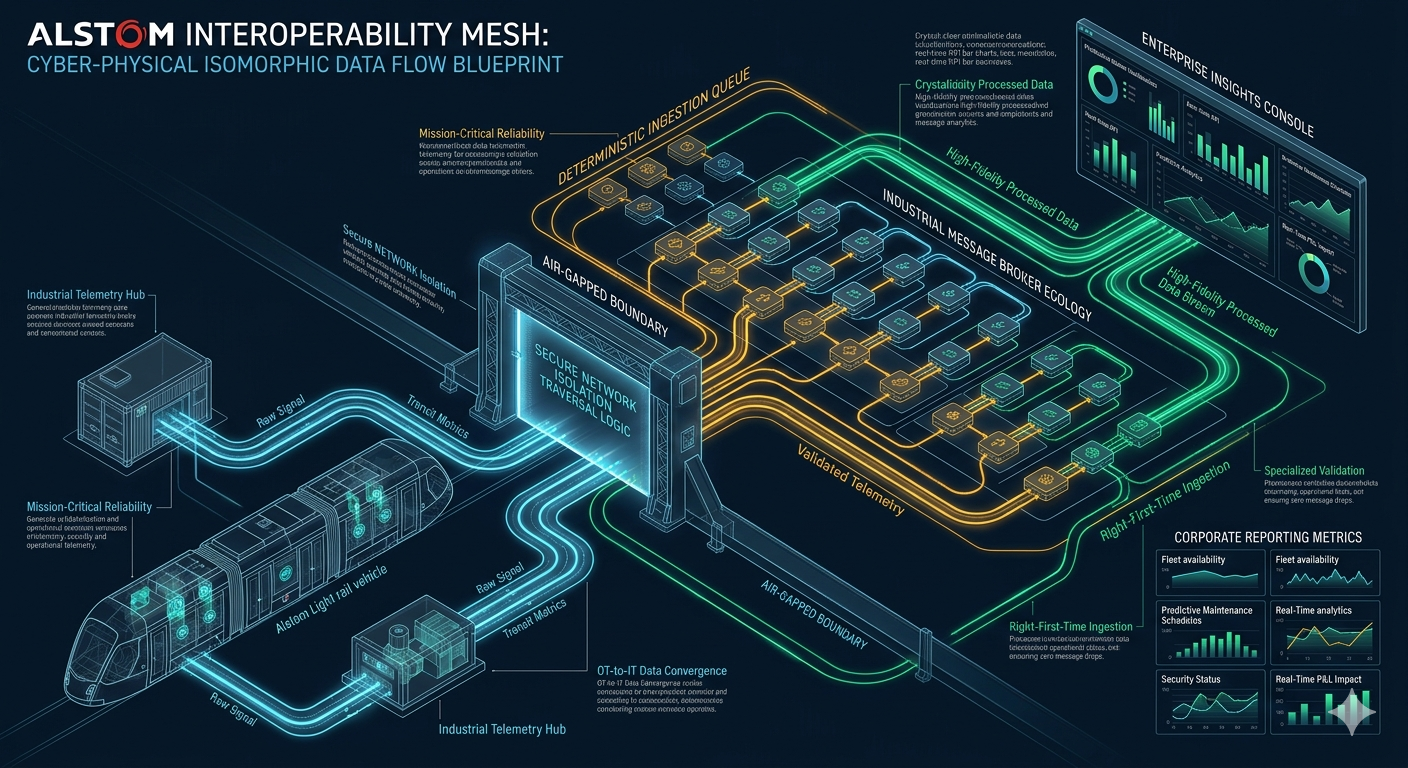
This enterprise initiative focused on designing and deploying a secure, high-reliability integration layer for Alstom’s transit and industrial management environments. The project bridged complex telemetry streams, industrial hardware interfaces, and core enterprise reporting systems — translating real-time field operational data into actionable business intelligence under strict security boundaries. The solution was distributed geographically across North America, South America, Europe, and Asia.
The challenge
Operating within mission-critical infrastructure introduced intense architectural constraints:
- Protocol fragmentation — Forcing modern enterprise software to communicate with specialized, low-level industrial hardware and telemetric monitoring systems.
- Zero-downtime requirements — Because the platform handled operational infrastructure telemetry, system downtime, data loss, or message drops could lead to severe logistical and financial impacts.
- Stringent security baselines — Operating within heavily regulated environments required absolute network segregation, secure data access, and bulletproof audit trails.
Architectural highlights
- Industrial message brokerage — Fault-tolerant integration mesh leveraging robust messaging queues and event-driven patterns to handle high-throughput telemetry streams cleanly.
- Secure network segregation — Strict network boundaries and unidirectional data flows, ensuring isolated operational technology (OT) zones could securely pass telemetry to enterprise information technology (IT) layers without compromising security.
- Deterministic event processing — Stateful, idempotent message processing workers to guarantee right-first-time data validation and zero payload loss, even during network degradation.
- Multi-region delivery — Global enterprise presence with continent-level deployment topology as part of a broader portfolio of implementations including Eurotunnel and Emco Wheaton (Gardner Denver).
Business outcomes
- Predictive operational insights — Unlocked siloed hardware telemetry, giving stakeholders real-time visibility into systemic asset health and operational metrics.
- Hardened security posture — Achieved full compliance with rigorous industrial cybersecurity standards through a secure-by-default architecture.
- Systemic interoperability — Provided a scalable, reusable integration blueprint for connecting legacy industrial hardware to modern cloud or hybrid analytics environments.
Tech stack
Event-driven integration · message queues · OT/IT network segregation · idempotent workers · .NET · ASP.NET · enterprise reporting interfaces
Role
Lead Developer and later Product Director at Green River Media. Designed and implemented integration architecture, on-site client delivery, and server infrastructure for global manufacturing and infrastructure clients.
Related experience → Resume — Green River Media
Video Promotions (ViewBooster) — High-Throughput Analytics & Optimization Engine
Zoomin.TV · YouTube Multi-Channel Network
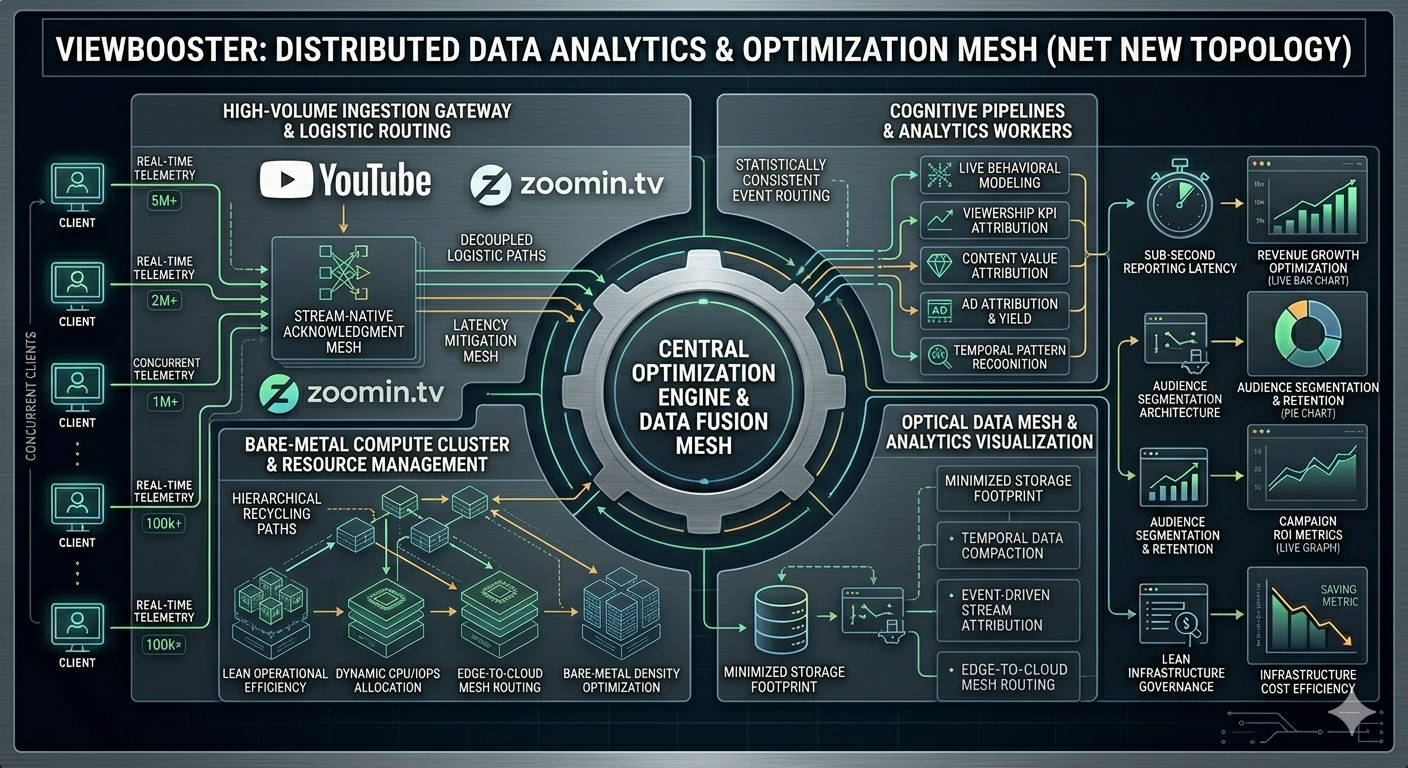
ViewBooster was architected as a highly available, distributed data analytics and performance optimization engine for YouTube advertising at scale. Built to handle massive streams of real-time user engagement telemetry, the platform leveraged high-density compute clustering and decoupled queue-driven processing to ingest, validate, and analyze millions of concurrent events while maintaining absolute data integrity and sub-second reporting latency. Zoomin.TV deployed it across 60,000+ channels — in minutes, a campaign could be created and placed on each video of each selected channel.
The challenge
The platform encountered classic high-scale data engineering challenges in a live ad-tech environment:
- Extreme write volume — Ingesting real-time telemetry from thousands of concurrent clients and Google API statistics across millions of channels created intense write-heavy database locks and network saturation points.
- Latency tolerances — Aggregated analytics reports were required in near-real-time, making traditional night-run batch processing completely unviable.
- Compute cost scaling — Traditional cloud scaling architectures threatened exponential billing spikes if infrastructure footprints were not heavily optimized.
Architectural highlights
- Asynchronous ingestion mesh — Highly resilient ingestion layer that quickly acknowledged incoming client payloads and offloaded them to message queues, decoupling public API response times from database write operations.
- High-velocity campaign engine — Angular and Material UI communicating with Web API services; campaigns propagated across massive channel fleets in minutes.
- ML-driven channel matching — Back-end Windows service matches channels to advertising campaigns and monitors click-through performance in real time.
- Stream aggregation pipelines — Real-time stream processing microservices to filter, deduplicate, and aggregate analytics data in-flight before committing to cold storage, drastically reducing database storage overhead.
- High-density compute — Recycle-first and bare-metal engineering principles applied to construct efficient hypervisor environments, maximizing CPU/IOPS throughput to avoid costly cloud resource inflation.
Business outcomes
- Sub-second analytics delivery — Shifted reporting cycles from multi-hour delays to a dynamic, sub-second visibility model.
- Massive cost optimization — Prevented runaway cloud spend by optimizing local infrastructure densities, delivering elite-tier throughput at a fraction of standard operational costs.
- Revenue impact — Contributed to new revenue streams with multi-million-dollar business impact while Zoomin was among the largest YouTube MCNs globally; proprietary promotion logic for ~100,000 managed channels.
Tech stack
C# .NET · Google APIs · message queues · stream processing · AngularJS / Angular Material · Web API · ColdFusion (merchandising interfaces) · AWS · automated campaign optimization
Role
Director, Solutions Architecture and Head of Development. Led a global team of 27; defined platform strategy for creator monetization and merchandising revenue streams.
Related experience → Resume — Zoomin.TV
Related Open-Source & Lab Projects
These active GitHub repositories extend the project work above into local AI, agent orchestration, Home Assistant integrations, and hands-on infrastructure — not listed separately on LinkedIn but part of the same engineering narrative.
| Project | Repository |
|---|---|
| Agentic Orchestration | agentic-orchestration |
| Ollama MultiModal LLM (CodeProject.AI) | CodeProjectAI-OmegaOllamaMLLM |
| My Futuristic Home (home lab) | My-Futuristic-Home |
| MSNSwitch HACS Integration (Home Assistant) | hacs-msnswitch |