Zlatko Lakisic

Private Networks Architect & Practice Lead · Enterprise Presales & Connected Solutions
Local AI & MCP Architecture
Why MCP Matters
Model Context Protocol (MCP) standardizes how AI agents discover and invoke tools — the same integration problem enterprise architects have solved with API gateways and ESBs, now applied to agentic workflows. Without a protocol boundary, every agent hard-codes tool integrations; with MCP, tools become pluggable services with explicit capability contracts.
For organizations evaluating AI automation, MCP provides:
- Composability — add Home Assistant, documentation search, or internal APIs without rewriting agent logic
- Governance surface — credential-scoped catalogs mirror enterprise service registries
- Vendor portability — swap Ollama for cloud models while keeping the same tool layer
- Auditability — structured request/response flows instead of opaque prompt stuffing
Enterprise Use Cases
| Use case | MCP role | Enterprise parallel |
|---|---|---|
| Operational automation | Agents invoke Home Assistant, MQTT, or internal REST APIs via MCP servers | Integration bus connecting line-of-business systems |
| Knowledge retrieval | Docs/search MCP servers feed grounded context into planners | Enterprise search and RAG pipelines |
| Multi-step workflows | CrewAI crews chain tool calls through a catalog | BPM/orchestration with human approval gates |
| Vertical packs | Domain overlays under examples/verticals/ |
Industry solution accelerators |
| Discovery workshops | YAML + env-var catalogs validate workflows before custom code | HLSD and POC scoping |
Security Considerations
MCP introduces the same trust boundaries as any integration layer:
- Credential scoping — backend and tool catalogs filter by environment credentials; agents only see what operators explicitly enable
- Network isolation — MCP servers run in segmented subnets (see Infrastructure VLAN design); tool reachability is deliberate, not ambient
- Local execution sandbox — inference and tool execution stay on owned hardware for privacy-sensitive workloads
- Least privilege — each MCP server exposes a narrow capability set rather than blanket system access
- Human-in-the-loop — high-impact actions remain gated by operator approval in production-shaped workflows
Enterprise deployments should treat MCP servers like microservices: authenticated endpoints, segmented networks, and logged invocation trails.
Local vs Cloud MCP
| Dimension | Local MCP (this portfolio) | Cloud-hosted MCP |
|---|---|---|
| Data sovereignty | Telemetry, video, and automation state stay on owned hardware | Data crosses provider boundaries |
| Latency | Sub-second tool round-trips on LAN | Depends on WAN and provider region |
| Cost model | Recycle-first bare-metal; no per-token egress surprises | Usage-based billing at scale |
| Model choice | Ollama, vLLM, JetStream on local GPU/TPU | Managed APIs (OpenAI, Anthropic, etc.) |
| Best fit | Edge AI, home-lab validation, regulated or air-gapped patterns | Burst capacity, frontier models, global teams |
The agentic-orchestration stack supports both — local backends by default, commercial APIs when credentials and latency profiles justify them.
Lessons Learned
| Lesson | Detail |
|---|---|
| Catalog before code | YAML workflows and env-var backend catalogs reduce POC friction more than bespoke planner glue |
| Separate planning from execution | LiteLLM planner + CrewAI crew mirrors enterprise separation of orchestration and worker services |
| VRAM-aware routing | Smaller models for planning steps; reserve large models for synthesis — directly reduces hardware spend |
| MCP is the integration hub | Resist one-off tool imports; every new capability should register as an MCP server |
| Pressure-test locally | Patterns validated on Proxmox clusters translate to client recommendations with real utilization data |
| Feedback loops matter | Session history and learning loops in the orchestrator mirror enterprise voice-of-customer pipelines |
Overview
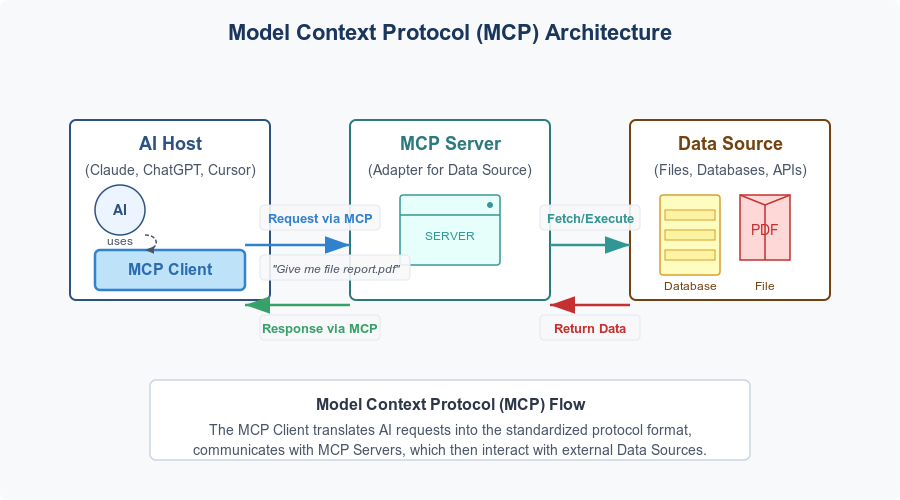
Standard MCP request/response flow: the client translates AI requests into protocol format; servers fetch from external data sources and return structured context.
This deep-dive covers self-hosted AI systems that extend enterprise integration thinking into edge inference: model-agnostic orchestration, multi-modal vision pipelines, and MCP tool servers that connect agents to real environments (Home Assistant, documentation, search, and custom catalogs).
Primary repositories:
System Architecture
Conceptual MCP flow
How context moves from data sources through MCP into local execution — the pattern this repository implements end to end.
graph TB
    subgraph DataLayer["Data Layer"]
        A[Context Data Sources]
    end

    subgraph OrchestrationEngine["Orchestration Engine"]
        B(Agentic Orchestration Layer)
        C[Ollama Inference Engine]
    end

    subgraph SecurityIsolation["Security Isolation"]
        D[Localized Execution Sandbox]
    end

    A -->|Model Context Protocol| B
    B -->|Secure Local Payload| C
    C -->|Multi-Modal LLMs| D
Orchestration blueprint
Detailed component flow across planning, model routing, backends, and MCP tool servers.
flowchart LR
    subgraph Input
        UI[Web UI / YAML Goals]
        API[REST / WebSocket]
    end

    subgraph Orchestration
        Planner[LiteLLM Planner]
        Crew[CrewAI Agent Crew]
        Router[Model Router]
    end

    subgraph Backends
        Ollama[Ollama Local]
        Cloud[OpenAI / Anthropic / HF]
        TPU[vLLM / JetStream]
    end

    subgraph Tools
        MCP[MCP Tool Servers]
        HA[Home Assistant]
        Docs[Docs / Search]
    end

    UI --> API
    API --> Planner
    Planner --> Crew
    Crew --> Router
    Router --> Ollama
    Router --> Cloud
    Router --> TPU
    Crew --> MCP
    MCP --> HA
    MCP --> Docs
The orchestration layer separates planning (which model and which steps) from execution (agent roles and tool calls). MCP servers act as the integration boundary — the same pattern as REST API adapters in enterprise architecture, applied to agent tooling.
Agentic Orchestration
Repository: github.com/zlatko-lakisic/agentic-orchestration
Architectural blueprint
- Natural-language goals and YAML workflows drive coordinated multi-agent crews.
- A LiteLLM-backed planner selects backends per task from a catalog filtered by credentials and hardware capability (CPU, GPU, TPU, VRAM heuristics).
- Optional MCP servers extend agents without hard-coding tool integrations.
- Vertical overlays under
examples/verticals/add domain-specific orchestrator context without forking core engine code.
Tech stack
| Layer | Components |
|---|---|
| Orchestration | CrewAI, YAML workflow definitions, dynamic planning modes |
| Model routing | Ollama, OpenAI-compatible APIs, Anthropic Claude, Hugging Face, vLLM, JetStream |
| Tooling | Model Context Protocol (MCP) catalog, Home Assistant, docs/search servers |
| Interfaces | CLI tool package, Web UI with local WebSockets, session and learning loops |
Key outcomes
- Vendor agnosticism — Teams adopt on top of existing models, credentials, and MCP tools, then blend commercial APIs when faster or good enough.
- Short path to POC — Catalog-driven configuration via environment variables instead of bespoke planner and tool glue.
- Production-shaped patterns — Knowledge base, learning loop, VRAM-aware routing, and vertical overlays mirror how enterprise platforms ship domain packs.
Design lessons
| Challenge | Approach |
|---|---|
| Latency on local hardware | Per-task backend selection with VRAM heuristics; prefer smaller models for planning steps |
| Context window limits | Session management and knowledge-base retrieval instead of stuffing full history into prompts |
| Tool sprawl | MCP catalog as integration hub — same role as an API gateway in distributed systems |
| Proof-of-concept friction | YAML + env-var catalogs so teams validate workflows before committing to custom code |
Multi-Modal LLM Integration (CodeProject.AI)
Repository: github.com/zlatko-lakisic/CodeProjectAI-OmegaOllamaMLLM
Architectural blueprint
Plugin for CodeProject.AI Server that routes image and video analysis through Ollama vision models. Video is handled via frame sampling and summarization rather than sending full streams to the model.
Tech stack
Ollama · CodeProject.AI module pipeline · Moondream (default vision model) · containerized execution
Key outcomes
- Self-hosted multi-modal inferencing inside an existing edge-AI server boundary.
- Data stays local — aligned with privacy-sensitive workloads in enterprise and home-lab contexts.
- Composable with the broader home infrastructure stack documented in Infrastructure & Home Lab.
Relationship to Enterprise Work
| Enterprise pattern | Local AI equivalent |
|---|---|
| API gateway / integration bus | MCP catalog and model router |
| Credential-scoped service catalog | Backend catalog filtered by env credentials |
| HLSD and discovery artifacts | YAML workflows and vertical overlays |
| Feedback loop to product roadmap | Learning loop and session history in orchestrator |
The same architectural instincts — bounded integrations, catalog-driven adoption, outcome-first scoping — apply whether the deployment target is a Fortune 500 private network or a Proxmox cluster in a home lab.